


In this guide:
- What is branding?
- What is rebranding?
- You don’t need to be struggling to need a rebrand
- How do you know when it’s time to rebrand?
- What should a strong brand identity actually give you?
- Your brand should feel like a world, not a moodboard
- Branding is hospitality
- What role does creative direction play in branding?
- Brand refresh vs. rebrand: which do you need?
- What does a professional rebrand include?
- What happens during the rebranding process?
- What should change after a successful rebrand?
- Frequently asked questions about rebranding
Most businesses are built piece by piece, usually in whatever order necessity demands. Which is exactly why rebranding your business can eventually become necessary, even when that business is wildly successful.
You needed a logo before you could open the doors, so you bought one on Etsy. You needed a website, so you stayed up too late one weekend figuring out how to build one yourself. Your best friend had a nice iPhone and a passion for photography, so she took your first headshots. You chose a couple of colors you liked, found some fonts in Canva, and got to work.
And the funny thing is, it actually worked.
People hired you, purchased from you, and bought into what you were selling. You got better at what you do, raised your prices, and started getting referrals. Your offers changed once you understood what your clients actually needed, and you developed stronger opinions about your work because you had enough experience to know what worked and what didn’t. Eventually you found yourself collaborating with other businesses, attending conferences, speaking, hiring help, opening locations, launching products, or serving clients you couldn’t have imagined working with when you first started.
The business grew into something real and substantial, but the branding was still made up of individual decisions you’d made while trying to get the thing off the ground. And now, every time you need to create something new, you feel like you’re starting over.
You don’t really know what your Instagram should look like, so you mostly share whatever photographs you happen to have and graphics other people have tagged you in. Someone tells you to post more consistently, you buy another pack of Canva templates, and three weeks later you’ve decided they don’t really feel like you anyway. The business cards you’ve needed for six months are still unordered because every design you make looks wrong.
You know you need new photographs. Probably a better logo. And definitely a better website. Maybe different colors? At this point, you have 327 pins saved to a Pinterest board called “branding” and 12 TikToks on replay explaining what a brand strategy is. You’ve been Googling rebranding your business from the bathroom, the airport, the school pickup line, and your bed at 11:14 PM while your husband snoozes next to you, and you still don’t know what you’re actually supposed to do first.
If that sounds painfully familiar, the problem may be bigger than Instagram or Canva or your photography, website, business cards, or any of the other individual pieces you’ve been trying to fix.
You may have simply outgrown the brand that got you here. And if so, the solution is a bit bigger than a nicer logo.
What is branding?
Branding is the intentional process of shaping how people experience, understand, remember, and talk about your business.
Your brand, then, is so much bigger than the visual pieces you use to represent it. It exists in the minds of the people who encounter your business, and it is shaped over time by what you say, what you make, how you serve people, what you look like, what you sound like, what you repeatedly do, and whether the experience you deliver lives up to what you promised.
That means your logo is part of your branding. Your color palette is part of it.
So are your photographs, website, packaging, proposals, signage, emails, Instagram graphics, printed materials, client gifts, presentations, customer service, onboarding process and all the other nine million tiny interactions that collectively teach someone what to expect from you.
Brand vs. branding vs. brand identity vs. visual identity
There is enough industry jargon around branding to make a person abandon the whole project and go binge Netflix instead, so here’s the simplest way to think about it.
Your brand is the perception and reputation that exists around your business. Branding is the intentional work you do to influence and shape that perception. In other words, your brand is what people come to know, believe, expect, and remember about you; branding is everything you’re doing to help shape those ideas.
Your brand identity gives you a system for expressing who that business is. It can include verbal elements like your messaging and voice alongside visual elements like logos, typography, colors, photography, illustrations, and other recognizable pieces. Your visual identity is the visible portion of that larger system.
Which brings us to the logo. Your logo is one piece of your visual identity—an important one, certainly, just not one capable of carrying an entire business on its back.
Why a logo alone isn’t enough to build a brand

This is where a lot of established businesses get stuck. You technically have branding because you have a logo. You might even have several logo variations and a document—or Post-It somewhere—with your hex codes. But the moment you need to create something that isn’t your logo, you’re suddenly making creative decisions from scratch.
You don’t know what your photography should look like or whether illustration belongs in the mix. Designing a brochure means figuring out a layout style you’ve never established before, and creating an Instagram graphic somehow turns into another attempt to make something feel recognizably yours without slapping the logo in the corner. Then bigger projects come along—a conference booth, new packaging, a website, brick and mortar signage—and you’re trying to decide whether the business should feel editorial, playful, historic, polished, warm, bold, or something else entirely.
What does your brand look like when the logo isn’t on it?
That’s the question a logo was never designed to answer on its own. A logo can identify your business, but a visual identity gives your business a language. And for a lot of successful business owners, the difference between owning a logo and having a brand you can actually use doesn’t become obvious until the business has grown large enough to need that language.
What is rebranding?
Rebranding is the process of intentionally changing how a business is positioned, expressed, or perceived so that its brand more accurately reflects what the business is now and where it’s going in the future.
Depending on what the business needs, that might involve strategy, positioning, messaging, creative direction, a new or refined visual identity, photography, website direction, packaging, physical environments, customer touchpoints, or other parts of the brand experience. Sometimes the logo changes completely, sometimes we refine what’s already there, and sometimes it doesn’t need to change at all.
What rebranding doesn’t automatically mean is that something has gone wrong. Needing a rebrand isn’t evidence that your business is failing or that the branding you started with was a mistake. In fact, I would argue that success gives us some of the best raw material for creating a meaningful rebrand.
Why successful businesses need to rebrand, too

Look at established companies that have rebranded throughout their history. Even a company as recognizable as Coca-Cola continues to evolve its identity while preserving the pieces that carry enormous brand equity. They don’t do it because the previous iteration of the company necessarily failed. They do it because businesses don’t remain static.
Markets and customers shift, culture and technology move forward, products evolve, leadership changes, and the ambitions of the company itself become bigger or simply different.
And all the while, successful businesses are accumulating something incredibly valuable:
HISTORY.
After years in business, you have actual evidence that didn’t exist when you created your first brand. You’ve had hundreds of client conversations and know why people really hire you instead of why you thought they would when you first opened. You’ve discovered which services are most valuable, which parts of your process clients rave about, what frustrates them, and where your own strengths lie. There are testimonials and stories now, along with relationships, recognition, trust, and opinions you couldn’t possibly have developed six months into business.
That success gives us something substantial to work with. A good rebrand isn’t an attempt to manufacture substance where none exists. It takes the substance you’ve already built and finds a stronger way to express it verbally, visually, and sometimes even through sensory details like scent and touch.
Your first brand didn’t fail you
I don’t particularly love the idea that every DIY brand is a mistake waiting to be corrected by a professional designer. Sometimes a new business needs proof of concept more than it needs a five-figure creative project.
If the logo you bought for a couple hundred dollars helped you put a name on the door and start taking clients, it did its job. The website you built yourself brought in inquiries? Fantastic. Your best friend took the photographs you needed to announce your business? Wonderful. Those choices weren’t necessarily wrong; they were made for a particular version of the business at a particular point in its growth.
Years later, you may simply be asking that brand to represent a business that doesn’t truly exist anymore. And that’s where I think rebranding becomes an act of stewardship.
We’re not walking into a successful business, throwing everything it’s built into the dumpster, and lighting it on fire. We’re looking carefully at what’s already there: the things that have become recognizable, the pieces that have earned equity, the stories and details your clients genuinely love, and the parts of the business that have remained meaningful through years of change. Some of those things deserve to come forward with us. Others may have done their job beautifully and simply no longer belong in what we’re building next.
The goal is to understand your history well enough to know what deserves to become part of your future.
You don’t need to be struggling to need a rebrand
One of the biggest misconceptions about rebranding is that you should wait until the current brand starts hurting sales.
I believe that’s really narrow thinking.

Your clients love you, you’re booked, and you’ve built an excellent reputation. You’ve reached the point where you’re being invited into rooms, collaborations, and opportunities you once hoped for. On paper, the business is doing exactly what you wanted it to do (and your bookkeeper is probably really happy). And yet, every time someone asks for your website, there’s still that tiny voice in your head saying, Please don’t judge me based on that.
The need for a rebrand can be external, certainly. You may be trying to reach a different market, introduce a new offer, increase your prices, or change public perception. But sometimes the disconnect is entirely internal: you know the way your business presents itself doesn’t do justice to the business you’ve actually built.
That lack of confidence matters. Not because confidence magically pays the bills, but because when you don’t believe your brand represents you well, you start working around it instead of with it. You hesitate to share the website, put off creating the brochure, avoid showing up consistently in your marketing, or cobble together something entirely new every time you need it.
And eventually, you’re spending a lot of energy compensating for a brand that should be making your job easier.
How do you know when it’s time to rebrand?
There isn’t a magic expiration date for branding. I don’t believe every business needs a new identity every five years simply because the calendar says so.
What matters is whether the identity you have can still accurately and effectively represent the business using it.
Here are some of the places I see that disconnect show up.
Your business looks like an earlier version of itself
The business you started may bear very little resemblance to the one you’re running today. What began as a single service has expanded into six, your clientele has shifted from individual consumers to organizations, your pricing has tripled, or the one-woman operation has grown into an actual team. You may have even developed a specialty that completely changed your position in the market.
The business evolved, but the branding stayed frozen in year one.
Take a look at your website through the eyes of someone who knows nothing else about you. Would they correctly guess the caliber of the business behind it? Would they understand what you’ve become—not simply where you started?
You’re hesitant to send people to your website or social media
Sometimes the disconnect is surprisingly subtle. You don’t necessarily hate your website or cringe every time you open Instagram, but you’ve developed a habit of explaining them away before anyone even has a chance to form an opinion.
You’ll send the link with a quick, “I’m actually about to redo this,” or mention that the photos are outdated. Maybe you even point out the page you haven’t updated or reassure someone that the website doesn’t really reflect the business anymore.
The issue is, you’ve been giving versions of that disclaimer for three years.
That instinct to explain away your own brand is information worth paying attention to.
Marketing feels harder than it should
This is one of the biggest signs business owners overlook because it presents itself as a marketing problem rather than a branding problem.
You sit down to create an Instagram post and spend more time deciding what it should look like than what you actually want to say. The photos don’t feel quite right, the templates you bought last month already feel wrong, and the fonts keep changing because you’re still trying to figure out what actually feels like you. Eventually, posting the low-resolution photo from your camera roll feels easier than designing anything at all so you post it with a quick caption and call your marketing done for the day.
It’s easy to look at that frustration and conclude that you need a better social media strategy. And maybe you do! But a content calendar can’t tell you what your business should look like.
When every piece of marketing requires you to make foundational creative decisions all over again, marketing will always take more energy than it should.
You avoid creating marketing materials because you don’t know what they should look like
The business cards you’ve needed for eight months keep getting pushed to the bottom of the list, along with the brochure, presentation deck, lead magnet, signage, or new client materials. You know exactly what needs to go on them, but every attempt to actually design them feels wrong.
Eventually, you either avoid creating them altogether or throw something together because you need it by Thursday—and you’re never particularly happy with the result.
Without a clear visual system to work from, even the simplest piece can turn into a frustrating creative task.
Your branding is consistent…and still forgettable
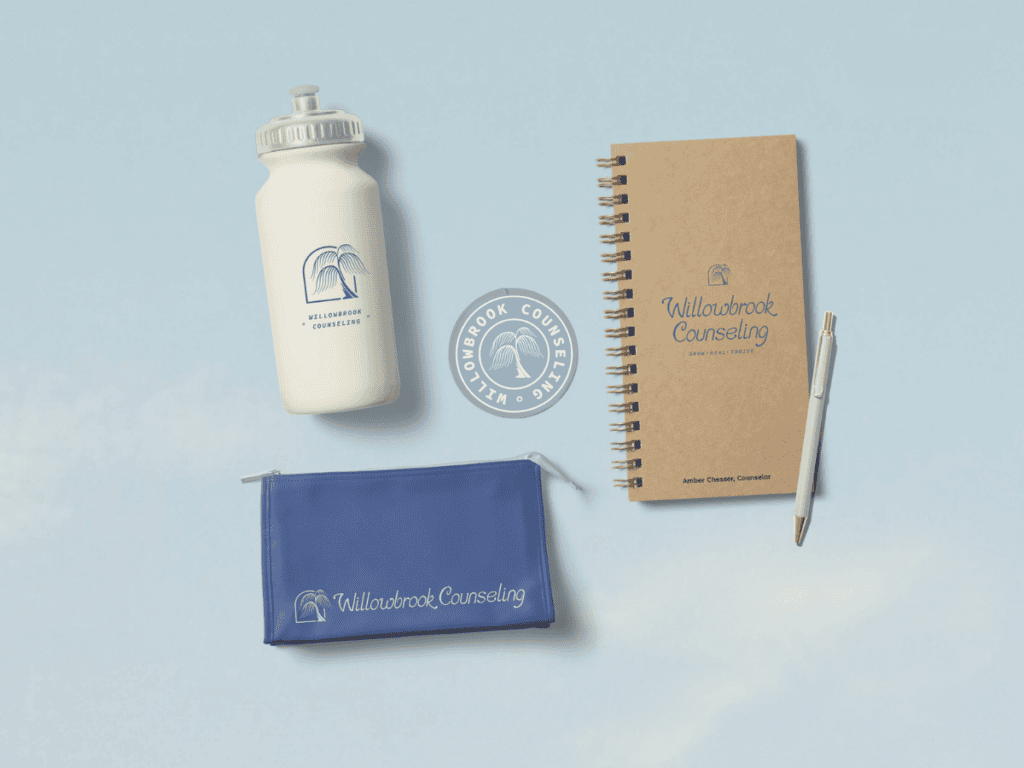
This is an important one because consistency alone does not make a strong brand. You can faithfully use the same two fonts, four colors, and logo on everything you create and technically be extremely consistent without giving people much to remember.
A strong identity has more depth than repetition. There are visual ideas people begin to associate with you: a distinctive approach to photography, recurring graphic elements, recognizable typography or composition, illustrations, textures, or other details that give the brand character. Ideally, those pieces become familiar enough that someone can recognize your business without even seeing the logo.

Consistency creates familiarity, which is valuable, but a sticky identity gives that familiarity something meaningful to attach to.
Your brand looks inconsistent even though the individual pieces are beautiful
The opposite can happen, too. You may have invested in an incredible photographer, a talented logo designer, a beautiful website, custom illustrations, and professional social media graphics. Each piece is genuinely good work, but when you put them all together, they don’t quite feel like they came from the same world.
That doesn’t necessarily mean anyone did a poor job. The problem may simply be that no one was responsible for the whole.
Without an overarching creative direction, every person you hire is left to interpret your brand independently. And even five very talented creatives can come up with five very different interpretations.
This is one of the biggest reasons creative direction matters: someone needs to hold the vision that every individual creative decision is being made within.
Your referrals are setting an expectation your brand doesn’t reinforce
That was one of the challenges behind my work with attorney Lindsay Lieberman: the business already had credibility and a strong referral-driven reputation, but the brand and website needed to communicate that same caliber.
A strong referral can get someone incredibly excited to work with you before she gets to meet you. Someone she trusts has already told her you’re talented, experienced, worth the investment, maybe even the person she needs to hire.
Then she Googles you.
And for the first time, she’s forming her own impression.
Your website, photography, social presence, and visual identity may be the first things she personally experiences from your business. If what she finds feels noticeably less polished, established, or thoughtful than the glowing recommendation she just received, there’s suddenly a little friction where there wasn’t any before. She may not consciously think, Her branding doesn’t accurately represent the caliber of her work. She just knows something feels a little off.
Ideally, the opposite happens. Someone says, “You HAVE to work with her,” she looks you up, and everything she finds makes her think, “Ohhh, I see why.”
Your branding doesn’t need to replace the reputation you’ve built through great work and word of mouth—and frankly, it couldn’t. It should make her own first impression feel consistent with the reputation that reached her first.
What should a strong brand identity actually give you?
A strong brand gives your business a visual language

When I create a visual identity, I’m not trying to fill a folder with individually beautiful assets. I’m trying to give the business enough of a visual vocabulary to communicate well.
Your logo and colors are part of that vocabulary, but so are typography, photography, illustrations, patterns, textures, graphic elements, layout principles, composition, styling, motion, and whatever else makes sense for the particular business we’re building.
You can see how those pieces work together across very different industries in my brand and website portfolio.
And none of those pieces should exist simply because a branding package is supposed to come with a certain number of deliverables. They should give us something meaningful to pull from when we’re making creative decisions in the future.
The goal is to build enough of a visual language that we can create something we’ve never made before and still know, yes, that belongs to this brand. You shouldn’t have to spend forty-five minutes browsing the Canva Elements library every time you need a graphic, hoping you’ll stumble across something that feels right. A strong brand identity gives you a visual ecosystem to pull from—and enough direction to know what belongs in it.
You don’t need every marketing piece designed before you launch your rebrand
A comprehensive brand doesn’t mean designing every conceivable thing your company might ever need before you’re allowed to launch it. We don’t have to predict the client workbook you’ll create three years from now; we need to build a visual system robust enough that when you do need that workbook, we already have the pieces and direction to know what it should look like.
Think of the identity as a language. We’re establishing the vocabulary and grammar, not pre-writing every sentence your business will ever need to say. When something new comes along—a campaign, presentation, event, product, Reel, or some marketing idea we couldn’t possibly anticipate today—you have enough of the language to create it without starting over.
That’s one reason creative direction matters so much to me. I don’t want to give you six finished templates that work beautifully until you need a seventh thing. I want to give your business a custom universe you can continue creating inside.
Your brand should feel like a world, not a moodboard
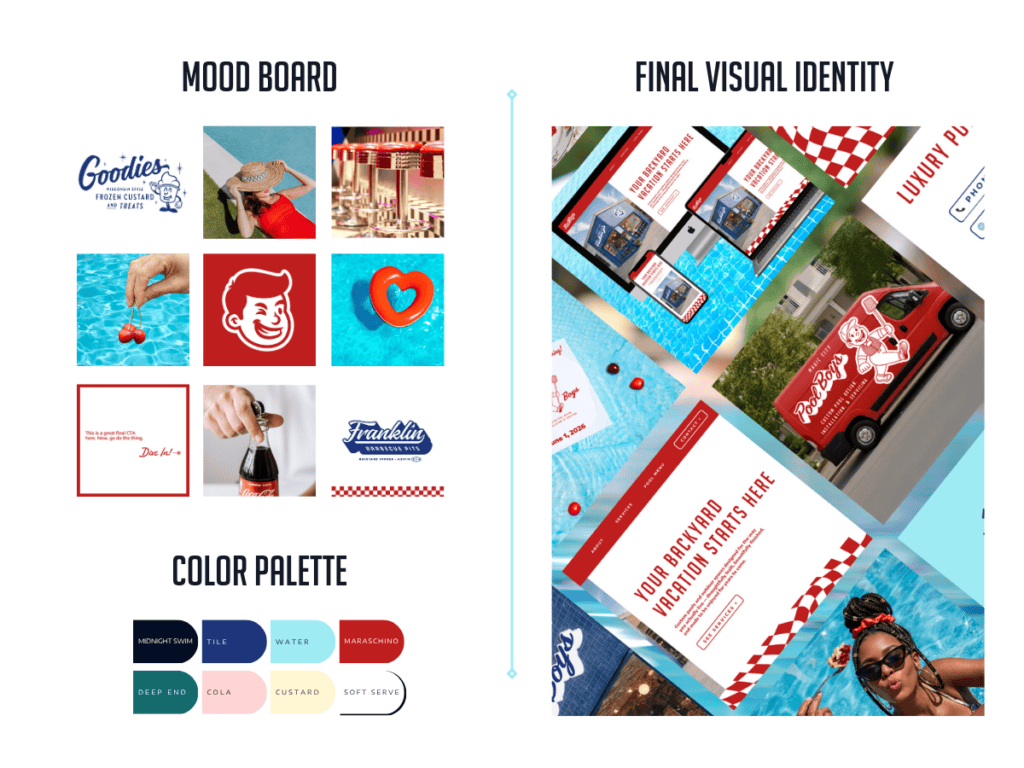
Moodboards are useful tools—I use them all the time—but inspiration isn’t the end goal. A brand world has character, recurring ideas, references, associations, texture, and its own internal rules. As that world becomes more developed, you begin to instinctively understand what belongs there and, just as importantly, what doesn’t.
Where we find the material to build that world depends entirely on the business. For a personal brand, the founder’s actual life can give us plenty to work with. Her history, personality, place, experiences, values, interests, expertise, family, and even her quirks can become meaningful parts of the visual vocabulary. We can pull from the real stories that shaped her and allow the brand to feel deeply personal without turning her entire life into a marketing campaign.
But a compelling brand doesn’t have to be autobiographical. Sometimes we’re creating a concept around the business instead—a setting, atmosphere, character, point of view, or even a somewhat fictionalized story that gives us a richer way to communicate what the company stands for. The details don’t have to be literally true for the story they’re telling about the business to be true.
Either way, we’re trying to understand the substance underneath it all: why this company exists, what it values, who it’s for, what it promises, how it wants people to feel in its presence, and what we hope they’ll remember after they leave.
That kind of meaning matters even more in an era when creating polished visual content is becoming easier and easier. The real differentiator isn’t simply whether a brand can make something beautiful, but whether it’s building recognizable ideas, associations, and meaning around itself.
The visual identity gives us a way to make those answers visible.
Branding is hospitality

I think about branding a lot like I think about hosting. Good hospitality doesn’t begin when someone walks through the front door. You’ve already thought about her hours, or even days, before she arrives.
You consider where she’ll sit, what she might need, whether she’ll know where to put her coat, what you’re serving, what music is playing, whether there’s a clean hand towel in the bathroom, and, obviously, whether there’s enough coffee.
Some of the most memorable details are the ones no one would have thought to ask for. They’re the little moments that make someone realize, Oh. They thought of me. I am cared for.
Branding gives us an opportunity to do the same thing throughout someone’s experience with a business. It can be as practical as clear website navigation that doesn’t make someone hunt for what she needs, or an onboarding process that answers questions before a new client has to ask them.
It can also show up in the unexpected details: a tutorial you created because you know exactly where clients tend to get stuck, an extra call built into the process when they’re most likely to feel overwhelmed, or a printed piece that arrives in the mail when everything else in your industry has gone digital.
And then there are the details that exist almost entirely to create an experience. A signature scent tucked into a client gift can eventually remind someone of working with you. Thoughtful packaging can turn opening an ordinary shipment into a fun little ritual they’re dying to share on TikTok. None of those things is strictly necessary, but I mean, hospitality has never been about doing only what is necessary.
Southern Glamping & Events is a good example of this idea translating into a brand built around hospitality and experience rather than simply a logo.
So those details may seem far removed from logo design, but they’re very much part of the brand experience. You’re creating a universe people are invited to step into, and it shouldn’t only look thoughtful from the outside. The real opportunity is to actually be thoughtful in the way people experience it.
What role does creative direction play in branding?
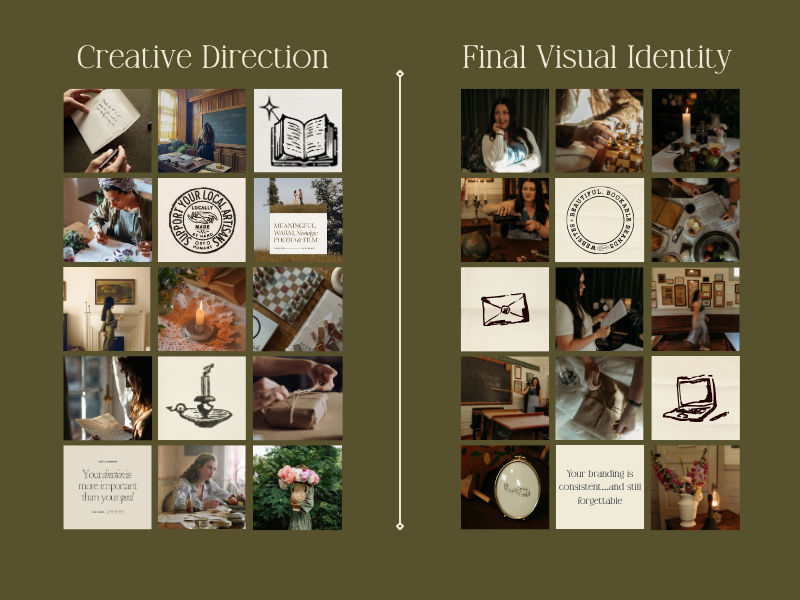
This brings us to one of the foundational parts of how I approach branding: creative direction.
Creative direction establishes the larger creative vision for a brand and gives all the individual decisions we make afterward something to answer to. I think of it as being able to see the business from a 30,000-foot view and then zoom aaaall the way in.
From 30,000 feet, we’re establishing the world we’re building: how this company should feel, what story we’re telling, which ideas should recur, and what ultimately belongs within it.
Then we have some fun getting granular. We can decide how a business card should feel in someone’s hand, how a photographer should light a shoot, whether illustration adds something meaningful, how a website should use space, or whether the typeface, packaging, campaign, or Reel we’re considering actually feels like it came from this business.

Instead of looking at every font, photography style, Canva element, illustration style, or creative trend as a possibility, we’re choosing from a much smaller set of possibilities that make sense for the brand we’ve already established.
The more developed that direction becomes, the easier it is for everyone who touches the brand—whether that’s you, me, a photographer, a copywriter, or someone you hire five years from now—to create something that belongs.
That larger creative vision is also why brand identity design is the foundation of my client work rather than a standalone logo.
Creative direction makes individual brand decisions work together
Think about hosting a dinner. You could hire an incredible florist and chef, choose beautiful china, light the perfect candles, and make a fantastic playlist. Every individual piece could be gorgeous on its own and still feel completely wrong sitting next to the others. Someone has to know what kind of evening we’re creating in the first place.
That’s how I think about creative direction, and it’s why my role with clients extends beyond creating a visual identity. I’m their creative partner. Sometimes that means I’m executing the work myself; other times I’m bringing in and directing the photographer, copywriter, illustrator, motion designer, developer, or another specialist who can execute a particular piece better than I can.
I don’t need to personally make every creative thing your business will ever need. I need to make sure there’s a vision clear enough that everyone who touches the brand understands what we’re building together.
Someone has to be responsible for the whole brand

And while the founder should absolutely be involved in shaping that vision, I don’t think she should have to be the only person responsible for holding all of it. You know your business better than anyone. You should have opinions, preferences, ideas, and a meaningful voice in how it’s represented.
But you also have clients to serve, a team to lead, decisions to make, and an actual company to run. You shouldn’t have to personally remember how the photographer should crop an image, whether a new illustration style fits, or which layout direction your social media manager should follow.
Part of my job as your creative partner is to take the vision we’ve established together and carry it with you. That gives you someone who can zoom back out when a new idea comes along, see how it fits into the larger ecosystem, and then give the people executing it the direction they need.
Your fingerprints should be all over your brand. You just shouldn’t have to be its full-time creative director on top of being its founder.
Brand refresh vs. rebrand: which one do you actually need?

These terms are sometimes used interchangeably, but generally, a brand refresh updates the expression of an existing brand while preserving most of its strategic foundation. A rebrand goes deeper, reconsidering more fundamental pieces of the business’s positioning, identity, story, or creative direction.
I’ve also broken down a real-world city rebrand—and why one version worked better than another—in my analysis of Pensacola and Florence.
If the core of your brand still fits but the execution has become dated, limited, or inconsistent, a refresh may be enough. You might have a recognizable logo that’s still serving you well but need stronger typography, an expanded color system, new photography, better supporting graphics, or clearer guidelines that make the identity easier for your team to use.
A full rebrand makes more sense when the questions you’re asking aren’t really about aesthetics anymore. The audience or company itself may have changed, your positioning may have evolved, or the existing identity may represent a version of the business that no longer exists. At that point, polishing the presentation doesn’t solve the deeper disconnect. We need to reconsider what the brand is communicating in the first place.
You can see this distinction in real-world rebrands, too. ESW Beauty’s recent rebrand went well beyond changing how the packaging looked; it accompanied a broader evolution in the brand’s positioning, product strategy, and approach to reaching its Gen Z customer.
What if you’ve been in business for years but never really had a brand system?
This is where neat industry terminology gets messy. Plenty of established businesses have used the same logo and signature color for years and built real name recognition around them without ever having a larger strategy, creative direction, photography direction, supporting visual elements, or cohesive identity system.
So are we refreshing the brand that exists? Rebranding the business? Professionally branding it for the first time?
Truthfully, I care a lot less about putting the perfect label on the project than I do about understanding what’s missing. An established business may have valuable pieces worth preserving while still needing us to build an entire creative system around them for the first time.
The scope should come from the gap between what you already have and what the business needs next—not from trying to squeeze your business into a predetermined definition of a “refresh” or “rebrand.”
Do you have to change your logo when you rebrand?
A rebrand doesn’t automatically require replacing every recognizable piece of the old identity. Your existing logo may have real equity, a particular color may be deeply associated with the company, or a symbol or visual element may carry history and meaning that would be foolish to discard simply because we’re making something new.
Sometimes the right answer is simply to refine what already works. A well-known logo might need its proportions cleaned up, typography adjusted, or details simplified so it performs better at small sizes and across digital applications. We might create new variations so it can adapt more naturally to different touchpoints without losing the core elements that make it recognizable. To the people who already know the brand, it should still unmistakably feel like your logo—just better equipped for the places it needs to live now.
This is where stewardship matters. Part of rebranding an established business is understanding what has already earned its place. We investigate those pieces before deciding what should stay, what could evolve, and what has genuinely run its course.
Change for the sake of change isn’t strategy.
What does a professional rebrand actually include?

There isn’t one universal checklist because different businesses require different things.
A law firm and a boutique hotel should not automatically receive identical branding deliverables simply because both hired a brand designer.
But a thoughtful professional rebrand usually requires us to work through several layers.
My Brand Identity Design service is built around exactly this principle: the scope is shaped around what the business actually needs rather than a one-size-fits-all package.
Brand research and competitive research
Before I decide what anything should look like, I need to understand the business I’m looking at: its history, audience, reputation, competition, values, goals, challenges, and the perceptions that already exist around it. I want to know what the founder believes about the business, what has changed since it began, what has remained remarkably consistent, and where she hopes to take it next.
This is where rebranding an established business gets especially interesting, because we aren’t inventing ideal answers. We have years of evidence to work from. We can look at the clients you’ve attracted, the work you’re known for, the feedback you’ve received, the offers that took off, the things people repeatedly mention when they refer you, and even the parts of the business that evolved differently than you originally expected.
Brand strategy and story
Once we understand what already exists, we can get clearer about what the brand actually needs to communicate. We’re looking for the point of the business, what makes it meaningful and different, which ideas deserve the most emphasis, and what we ultimately want someone to understand and remember after encountering it.
This gives the creative work something to be rooted in. The colors, typography, imagery, graphics, and other decisions we make later shouldn’t exist simply because they look good together; there should be a reason we’re choosing them and something they’re helping us communicate.
Creative direction
This is where strategy begins becoming a whole visual world. We’ve done the research and identified what the business needs to communicate; now we start exploring what those ideas could actually look and feel like when they’re made tangible. We establish the larger creative language through atmosphere, styling, photography, texture, typography, composition, illustration, movement, and whatever other cues make sense for the direction we’re building.
I’m considering how those pieces work together and the associations they naturally carry. Photography can make the same business feel intimate, editorial, playful, or clinical. Typography can introduce history, authority, warmth, or personality. Texture, composition, illustration, and styling all give us additional ways to communicate something about the business.
By the time we’re designing logos, choosing typefaces, planning a photoshoot, or developing supporting graphics, we’re no longer staring at an infinite number of beautiful options and asking which one we like best. We know the world we’re building, which makes it much easier to recognize what belongs in it—and gives us a creative foundation to return to long after the initial rebrand is finished.
A flexible visual identity system
Once the direction is established, we build the actual visual system. That might include a primary logo and secondary marks, typography, color, patterns, illustrations, graphic elements, icons, textures, photography direction, or other assets that make sense for the business. What belongs in that system should be determined by how the brand actually needs to live in the world.
Example deliverables
A restaurant, for example, has menus, signage, takeout packaging, uniforms, social media, and a physical space to consider. Its identity might benefit from a flexible family of marks, patterns, illustrations, or other elements that can make a tiny matchbook feel connected to a twenty-foot sign.
A hotel has an even larger physical ecosystem to build. The identity may need to carry through room keys, wayfinding, toiletries, linens, stationery, in-room materials, staff uniforms, restaurant spaces, and all the little details a guest encounters throughout a stay. There may be opportunities for custom illustration, pattern, iconography, or even sensory elements that simply wouldn’t be useful to another kind of business.
A law firm has completely different needs. It may rely much more heavily on strong typography, photography, editorial layouts, presentation materials, documents, signage, and a flexible logo system that can move comfortably between a website, a conference presentation, and a beautifully printed piece without feeling either stuffy or unserious.
A wedding planner works in an incredibly visual industry, so photography direction may carry much more weight. She may also need an identity that works beautifully alongside dozens of different wedding aesthetics without disappearing into them, plus thoughtful materials for proposals, planning documents, welcome gifts, vendor communication, and the client experience.
And a copywriter may need relatively few physical applications at all. Her words are the product, so typography and layout could become some of the hardest-working parts of the identity, supported by photography, a recognizable graphic language, and enough flexibility to make educational content, long-form writing, emails, and her website feel unmistakably hers.
None of those businesses needs the exact same box of brand assets. The goal is to build the visual vocabulary this business needs to communicate well, across the places its clients will actually encounter it.
Brand guidelines that make the identity usable
A beautiful identity isn’t especially useful if you have no idea what to do with it once the designer leaves. Your brand guidelines should help you understand how the system actually works: how the typefaces interact, which colors serve which purposes, what kind of photography belongs, how your graphic elements can be used, and where there’s room to experiment without losing the integrity of the brand.
They also give everyone else who touches the brand a shared reference point. You shouldn’t have to personally explain the vision from scratch every time you hire a photographer, bring on a social media manager, order signage, or hand something off to a new designer. The guidelines give them enough context to enter the world we’ve built and create within it.
Bringing the brand to life across real-world touchpoints
Eventually, the identity has to leave the presentation deck and start doing its actual job. It becomes the website someone visits after a referral, the business card you hand out at a conference, the proposal you send to a potential client, the packaging that arrives on someone’s doorstep, or the signage they see when they walk through your door.
The exact touchpoints will look different for every business, which is why we don’t need to design all of them just for the sake of having them. We identify the places that matter most now and use the visual system we’ve built to bring the brand to life there. As new needs come up later—a campaign, client gift, presentation, email sequence, event, or something we haven’t even thought of yet—we already have a foundation to build from.
This is where branding stops being a folder of files and starts becoming something people can actually experience.
What happens during the rebranding process?
My branding process is intentionally straightforward: research, design, refine and deliver.

Research
This is where I get nosy. I want to understand what you’ve built, why it exists, how people experience it now, what’s working, what isn’t, where you’ve been, and where you’re trying to go. That includes digging into your business and audience, your existing brand, and the competitive landscape around you so we understand both the space you’re operating within and where there’s room for you to stand apart.
From there, I develop the brand strategy that will guide the creative work and begin researching visual inspiration. I’m looking beyond what’s simply trending or aesthetically appealing to find references, ideas, history, imagery, and unexpected connections that can help us tell your story. By the time I start designing, I don’t want to be asking what looks good. I want to have a clear idea of what we’re trying to say and a well-researched creative direction for how we might say it.
Design using the One Concept Method
Once the research and strategy are established, I move into design using the One Concept Method. Rather than presenting several completely different brand directions and asking you to choose your favorite, I use everything we uncovered during research to develop the single direction I believe best solves the creative problem we’ve defined.
That doesn’t mean you get one logo dropped into your inbox with a hope you like it! attached. The concept is developed as a larger visual system so you can see the thinking behind it and how it begins to live beyond the primary logo. We’re looking at typography, color, supporting elements, imagery, and real-world applications together so you can evaluate the brand as a whole, rather than choosing between three logos in isolation.
Refine
Next, we move into revisions and refinement. This is where we make the smaller adjustments that help everything feel just right—a slight hue change, an updated tagline, swapping an illustration, adjusting a detail in the logo, or another minor tweak that strengthens the system without changing the overall creative direction.
Because we’ve already done the strategic work and developed the concept as a whole, the revision process is about polishing what we’ve built together, rather than going back to the drawing board.
Deliver and put the brand to work
Once everything is refined and approved, I prepare the final identity system and guidelines so you have what you need to actually put the brand to work. Your files are organized for the different ways you’ll use them, your brand guidelines explain how the pieces work together, and you’re equipped to start applying the new identity with confidence rather than wondering what to do with a folder full of logos.
But I don’t think of delivery as the finish line. Your brand becomes more valuable through use. As you repeat its visual language, build recognition around it, and apply it across more of the business, the ecosystem we’ve created becomes richer and more familiar to the people experiencing it.
There will always be another photoshoot, campaign, printed piece, website update, event, product, or idea that didn’t exist when we launched the rebrand. That’s why I love continuing to work with clients as a creative partner afterward. We don’t need to design everything your business will ever need on launch day. We need to build a world strong enough that when something new comes along, we already know how it belongs.
What should change after a successful rebrand?

The goal isn’t simply for your business to become prettier. I love beautiful things—obviously, I became a designer on purpose—but beauty without meaning isn’t enough. A successful rebrand should make the business easier to creatively operate.
You have a visual vocabulary to work from instead of reinventing yourself every week. Your photographer understands what you’re trying to create, your website feels connected to your social presence, and the packaging looks like it belongs to the same company as the presentation deck. Marketing becomes less about figuring out what you should look like and more about deciding what you actually want to say. And yes, you can finally order those business cards you’ve been putting off for eight months.
Over time, all of that cohesion begins doing something else: building recognition. You’re repeating distinctive ideas, imagery, typography, colors, compositions, and other pieces of your visual world often enough that people begin associating them with you. You’re no longer relying on the same hex codes and a logo in the corner to make everything feel consistent; you’re building a brand with enough depth to actually stick.
And for an established business, perhaps the most satisfying change is that the way you present your business finally begins reinforcing the reputation you’ve already earned.
Maybe you don’t need another isolated fix
If you’ve made it this far, there’s a decent chance you’ve been researching rebranding for a while. What started as looking for a new logo probably led you to headshots, website design, messaging, color palettes, and more saved inspiration than you could reasonably use in a lifetime. You may have opened Canva, tried to piece some of it together yourself, and ended up right back where you started: you know something doesn’t fit, but you can’t see the whole picture clearly enough to know what needs to change.
And maybe the whole picture is exactly what you’ve been missing.
This is the role I want to play in my clients’ businesses. I want to understand what you’ve built and the history that got you here, uncover the story worth telling, establish the creative vision, and build an identity capable of carrying it. Then, when that vision needs a photographer, copywriter, illustrator, motion designer, or another creative specialist to bring it to life, I can help assemble and direct the people who belong there, too.
Because I don’t want to hand you a prettier logo only to send you right back into the same cycle of wondering what everything else should look like. I want to become your creative partner and give you a foundation we can continue building from as your business evolves. You’ll have a visual language with enough depth to tell your story, a world with enough room to grow, and someone who understands the larger vision well enough to help you steward it along the way.
You’ve already given me plenty to work with. Years of clients, reputation, experience, stories, growth, and proof that this business means something. My job is to help you decide what all of that should look like.
Explore Brand Identity + Creative Direction →
Frequently Asked Questions About Rebranding
What is rebranding?
Rebranding is the intentional process of changing how a business is positioned, expressed, or perceived. Depending on what the business needs, that can include brand strategy, messaging, creative direction, logo design, visual identity, photography, a website, and other important brand touchpoints.
A rebrand doesn’t always mean replacing everything that came before it. For an established business, it may involve preserving recognizable pieces with real value while building a stronger, more comprehensive identity around them.
How do I know if my business needs a rebrand?
You may need a rebrand if your current branding represents an earlier version of the business, marketing takes more creative energy than it should, your visual assets don’t feel connected, you’re hesitant to send people to your website, or the quality of your presentation no longer matches the reputation you’ve built.
Your business does not need to be struggling to need a rebrand. In fact, years of success can give us valuable history, customer insight, reputation, and proof to draw from when building the new identity.
What’s the difference between a brand refresh and a rebrand?
A brand refresh generally updates or expands the expression of an existing brand while preserving most of its strategic foundation. A rebrand goes deeper, reconsidering more fundamental pieces such as positioning, audience, story, perception, creative direction, or identity.
The distinction isn’t always perfectly clean. An established business may have a recognizable logo and years of name recognition without ever having had a comprehensive brand system. In that case, I’m less concerned with finding the perfect label for the project than determining what should be preserved, refined, added, or reconsidered.
Does rebranding mean I have to change my business name?
No. Many businesses rebrand while keeping the same name. Renaming should only be part of the process when there’s a strategic reason the existing name no longer serves the business.
Do I have to change my logo when I rebrand?
Not necessarily. An existing logo may have years of recognition or meaningful history that makes it worth preserving. Sometimes it only needs to be refined—cleaning up proportions or details, improving its performance for digital use, or creating additional variations for different applications while keeping the recognizable core intact.
A rebrand should investigate what has already earned its place before deciding what needs to change. Change for the sake of change isn’t strategy.
How often should a business rebrand?
There is no universal rebranding schedule. A business should consider rebranding when meaningful changes in its audience, positioning, services, reputation, goals, or direction have created a disconnect between the business itself and the way it is being presented.
Age alone isn’t a reason to replace a brand that’s still doing its job.
What does a professional rebrand include?
A professional rebrand may include brand research, competitive research, brand strategy, creative direction, logo design, typography, color, photography direction, illustration, patterns, textures, graphic elements, brand guidelines, and applications across important customer or marketing touchpoints.
Not every business needs every deliverable. A restaurant, hotel, law firm, wedding planner, and copywriter all need their brands to function in very different environments, so the identity should be built around the ways that particular business actually needs to communicate.
Should I rebrand before redesigning my website?
If you already know your branding no longer represents the business, I generally recommend establishing your new brand strategy, visual identity, and creative direction before investing in a website redesign.
Those decisions give the website a foundation to build from. Otherwise, the website project can quickly become the place where you’re trying to simultaneously figure out your typography, colors, photography, graphic style, messaging, and overall creative direction.
Can I keep parts of my existing branding?
Absolutely. A thoughtful rebrand should investigate what already has meaning, recognition, and value before deciding what needs to change. A familiar color, symbol, logo, or other visual element may deserve to come forward with you, either exactly as it is or thoughtfully refined.
Good stewardship means understanding what you’ve inherited from the old brand before deciding what to do with it.
Is rebranding worth it if my business is already successful?
Yes. A successful business can be profitable, referral-driven, and well respected while its owner is deeply frustrated by the way it presents itself.
Success also gives us something incredibly useful during a rebrand: evidence. Instead of inventing a brand in a vacuum, we can draw from years of clients, reputation, experience, feedback, growth, and the things people already associate with your business. A rebrand can turn all of that substance into a visual identity and creative direction that better represents what you’ve actually built.
Consider this your invitation to grab a coffee, pull up a chair, and tell me all about your business—then let’s figure out what your brand needs and build it together.
Some links on this page may be affiliate links. I only recommend tools I personally use and trust.

Website Planning 101

These resources are pulled directly from the same materials and frameworks I use with my clients — designed to help you think through your brand and website with more clarity and intention. Consider this a behind-the-scenes look at how I approach the work.
A peek inside my process
From the Studio Library

I create thoughtful brand identities and custom Showit
websites designed to bring clarity, cohesion, and direction to your business — so everything finally feels like it fits.
I’ve worked with businesses across a wide range of
industries, but the goal is always the same: build something intentional, aligned, and bookable.
And yes… it gets to look really good too.
